Nature article
on
Two Cultures: Collection
EXHIBITION
Nearly one-third of the world's amphibian
species are endangered, and countless have
already been lost. Frogs used to be creatures
of the wild, but are fast becoming creatures of
the lab — pickled, jarred and preserved as a
static piece of history.
Now some long-dead frogs are taking centre
stage as part of an exhibition at the University
of Kansas. Creatures from the university's
herpetology collection, along with some from
the Field Museum in Chicago, have been cast
in urethane in a floor-to-ceiling display of
froggy glory.
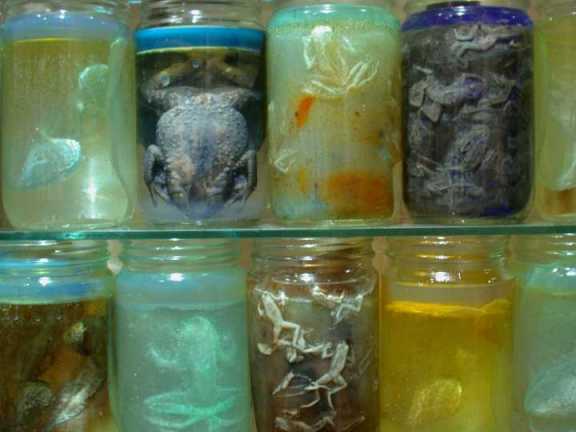 The show was created by Tracy Hicks, an
artist from Texas who has been fascinated by
natural-history collections since childhood,
when he hatched eggs from turtles, lizards and
snakes in his bedroom. The new installation
is his tribute to vanishing species and to the
science and art of collecting.
The show was created by Tracy Hicks, an
artist from Texas who has been fascinated by
natural-history collections since childhood,
when he hatched eggs from turtles, lizards and
snakes in his bedroom. The new installation
is his tribute to vanishing species and to the
science and art of collecting.
Floating in more than 1,300 jars are casts of
some 79 species of frogs and tadpoles, many of
them extinct, others endangered. They include
Atelopus ignescens — once so common in the
Andes that they would crunch frequently and
unpleasantly under the tyres of passing cars —
and the extinct golden toad of Costa Rica's
cloud forests. Other featured species are just
bizarre , such as the flying frogs from Asia or
the paradox frog, in which a tadpole 25 cm long
metamorphoses into an 8-cm frog.
In several cases, Hicks made his casts from
the species holotype. He practised for years
on less valuable specimens to perfect his
technique, and both museums, in Chicago and
Kansas, eventually
gave him
permission to work
with their priceless
specimens. “This
was an opportunity
to show that the
scientific collection
value to it, a certain
beauty,” says John
Simmons, manager
of the university's
collection and a
collaborator on
the exhibit.
Most strikingly,
Hicks' translucent
casts fluoresce
when an ultraviolet light is switched on,
transforming the wall of jars into an eerie
spectacle, where details such as skin
impressions pop out, glowing blue or green.
The effect communicates the life of the
animals. Audio recordings add to the
impression, with a frog chorus of now-vanished
species echoing their chants along the walls.
The exhibit, ‘Two Cultures: Collection’, will
remain on display until March 2006.
A.W.
In the croak room
TRACY HICKS
©2005 Nature Publishing Group
Site
Tracy Hicks
223 North Shore
Dallas, TX
75216-1030
